Paper jams and feeding
How to clean printer rollers safely and fix paper feeding problems
Written by Fix a Printer Editorial Team · Updated
Knowing how to clean printer rollers solves a surprising number of paper problems: a printer that does not pick up paper, grabs several sheets at once, feeds pages crooked or jams in the same place. Rubber rollers grip paper by friction. Over time paper dust, fibres, toner and coatings from labels and glossy paper build up on them, and the grip goes. Cleaning restores it in most cases, and it only takes a few minutes and a damp cloth.
This guide covers the safe method for both inkjet and laser printers, the built-in cleaning mode many printers have, and how to tell when cleaning is no longer enough.
Which problems roller cleaning fixes
- The printer does not pick up paper, or only after several tries: see printer not picking up paper.
- It takes several sheets at once: see printer pulling multiple sheets.
- Pages come out crooked: see printer printing skewed.
- Paper creases or wrinkles: see printer wrinkling paper.
- Marks or toner on the back of pages, which can come from dirty feed rollers.
If the printer reports a jam but no paper is visible, start with paper jam but no paper instead.
What you need
- A lint-free cloth, such as a microfibre cloth or a lens cloth. Paper towels and tissues leave fibres behind.
- Plain water. Tap water is fine; distilled water leaves no residue at all.
- A torch.
- Optionally, cotton buds for small rollers.
Do not use household cleaners, glass cleaner, solvents or sandpaper. Some makers allow a little isopropyl alcohol on their rollers and others do not, because it can dry out the rubber over time; check your user guide before using it.
Step 1: Switch off and unplug
Switch the printer off with its power button and unplug it. On a laser printer, wait several minutes so the fuser area at the back cools; it gets very hot.
Step 2: Find the rollers
Printers have several sets of rollers. The ones you can usually reach are:
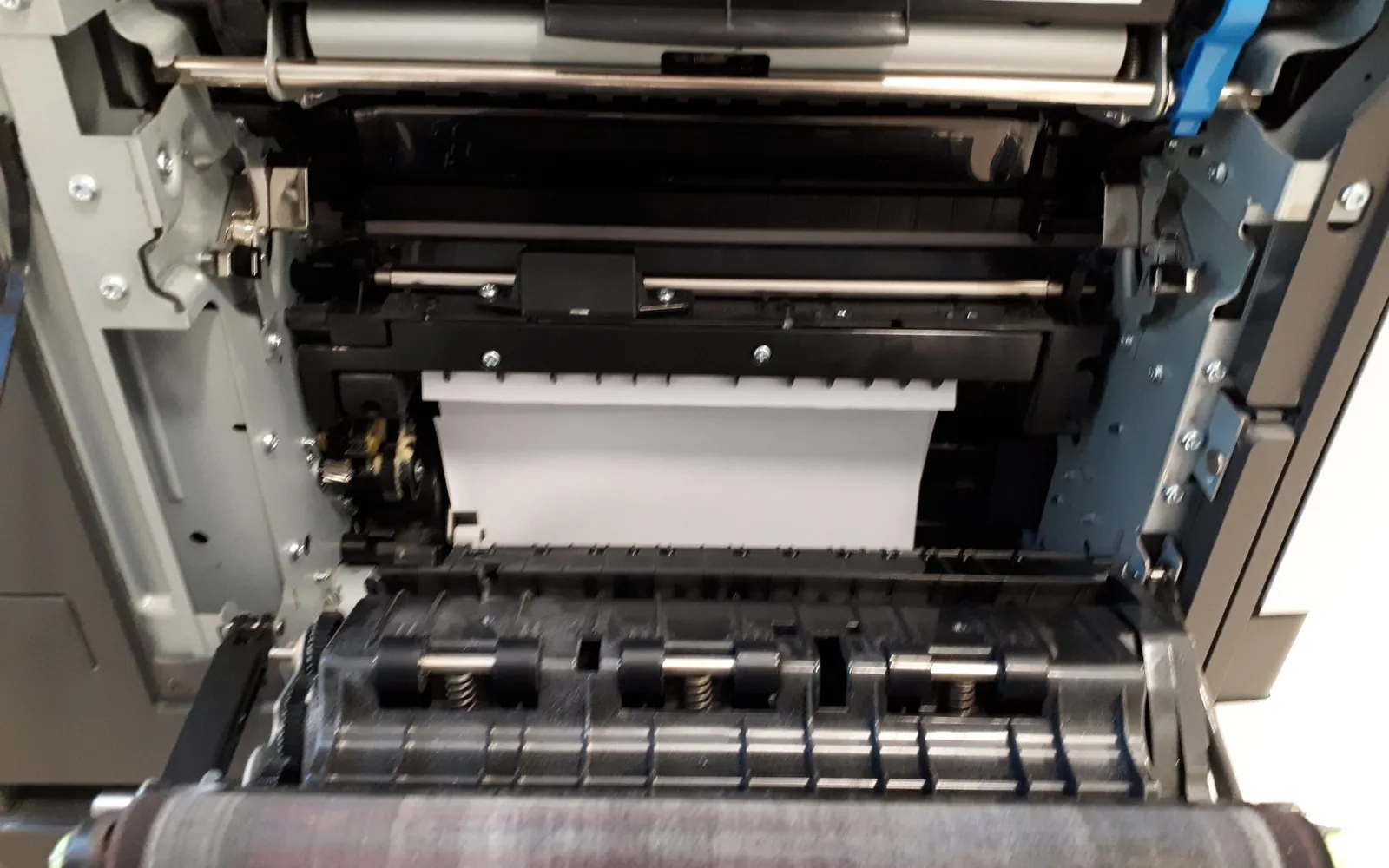
- Pickup roller: at the back of the paper tray opening, often in the roof of the cavity, it lifts the top sheet from the stack. Remove the tray to see it.
- Separation pad or separation roller: a cork, rubber or felt pad or small roller in the tray or the printer opposite the pickup roller. It stops several sheets going in together.
- Feed rollers: further along the paper path, behind the rear door or under the front cover.
- Rear tray or manual feed rollers: on printers that have a rear feeder.
- Document feeder rollers: on top of multifunction printers, under the feeder cover.
The user guide or the maker’s support pages usually show where they are for your model. On some laser printers, the pickup roller sits inside the toner cavity; follow the guide to reach it.
Step 3: Wipe each roller
- Dampen the cloth lightly with water. It should be damp, not dripping.
- Wipe the roller across its full width.
- Turn the roller with your finger to expose the next part, and wipe again, until you have gone all the way round. If the roller does not turn by hand, wipe the visible part and use the cleaning mode in Step 5.
- Look at the cloth: grey marks mean the roller was dirty. Repeat with a clean part of the cloth until little comes off.
Use cotton buds for small rollers you cannot reach with a cloth. Do not press so hard that you bend a roller shaft or move springs.
Step 4: Clean the separation pad
Wipe the separation pad or roller in the same way. A shiny, worn separation pad is a common reason for double feeds, even when the pickup roller is clean.
Step 5: Use the built-in cleaning mode
Many printers have a roller cleaning, paper feed roller cleaning or paper guide cleaning option in their maintenance or tools menu. Some feed plain paper through several times; some use a special cleaning sheet supplied with the printer. It reaches rollers you cannot reach by hand. Run it after the manual cleaning, following the on-screen steps.
Step 6: Dry and test
Let the rollers dry for a few minutes, reinstall the tray and plug the printer back in. Load fresh, dry paper, fanned and squared, below the fill mark with the guides touching the stack. Print a few pages and watch how they feed.
When cleaning is not enough
Cleaning cannot restore rollers that are worn out. Signs of wear:
- the rubber looks shiny or glazed rather than matte,
- it feels hard and smooth instead of slightly tacky,
- there are cracks, flat spots or uneven wear,
- feeding improves for a day after cleaning, then gets worse again.
Worn rollers need replacing. On many laser printers the pickup roller and separation pad are listed as user-replaceable parts with their own part numbers. On many inkjets they are not, and replacement is a service job. Check the user guide or the maker’s parts list before buying.
Keep rollers clean for longer
- Use good quality paper; cheap paper sheds more dust.
- Keep the paper in its wrapper until you load it, and do not overfill trays.
- Fan the stack before loading.
- Take extra care with labels: a label that peels off inside leaves adhesive on the rollers.
Quick checklist
- Printer off, unplugged and cool.
- Lint-free cloth lightly dampened with water; no cleaners or solvents.
- Pickup roller, separation pad and feed rollers wiped all the way round.
- Built-in roller cleaning mode run.
- Glazed, hard or cracked rollers replaced.
Frequently asked questions
What should I clean printer rollers with?
A lint-free cloth lightly dampened with plain water is the safe default. Some makers allow a little isopropyl alcohol on their rollers, others advise against it because it can dry out rubber; follow your user guide. Do not use household cleaners, solvents or anything abrasive.
How do I know if printer rollers are dirty or worn?
Dirty rollers look grey or dusty and often have paper fibres or toner on them. Worn rollers look shiny or glazed, feel hard or smooth instead of slightly grippy, or have cracks or flat spots. Cleaning helps dirty rollers; worn ones need replacing.
How often should I clean printer rollers?
There is no fixed schedule. Clean them when paper starts misfeeding, double feeding or jamming, and more often if you use dusty paper, labels, recycled paper or card.
Can I clean the fuser roller?
Leave the fuser alone unless your user guide gives a cleaning procedure. It gets very hot, can carry mains voltage, and its surface is easily damaged. Fuser problems are usually solved by replacement.
Sources
Editorial team
The Fix a Printer team writes and updates independent printer troubleshooting guides, checking Windows and macOS steps against Microsoft and Apple documentation.